
10 Proven Public Speaking Tips to Crush Your Next Presentation



The Ultimate Guide to Become a Better Public Speaker
We often look at leaders like Steve Jobs or Brené Brown and think, “I could never speak like them.”
This is the biggest myth.
Public speaking isn’t a talent; it is a muscle. Like any muscle, it can be strengthened with the right exercises. The difference between a nervous wreck and a confident presenter isn’t DNA—it is preparation.
So you might be thinking what makes a great public speaker? Effective public speaking isn’t about being an extrovert. It is the ability to communicate information clearly, engage an audience emotionally, and deliver a message with confidence—skills that anyone can master with practice.
Preparation: The Battle Is Won Before You Speak
Most people think the fear of public speaking kicks in when they step onto the stage. In reality, the anxiety starts days before, usually due to a lack of preparation.
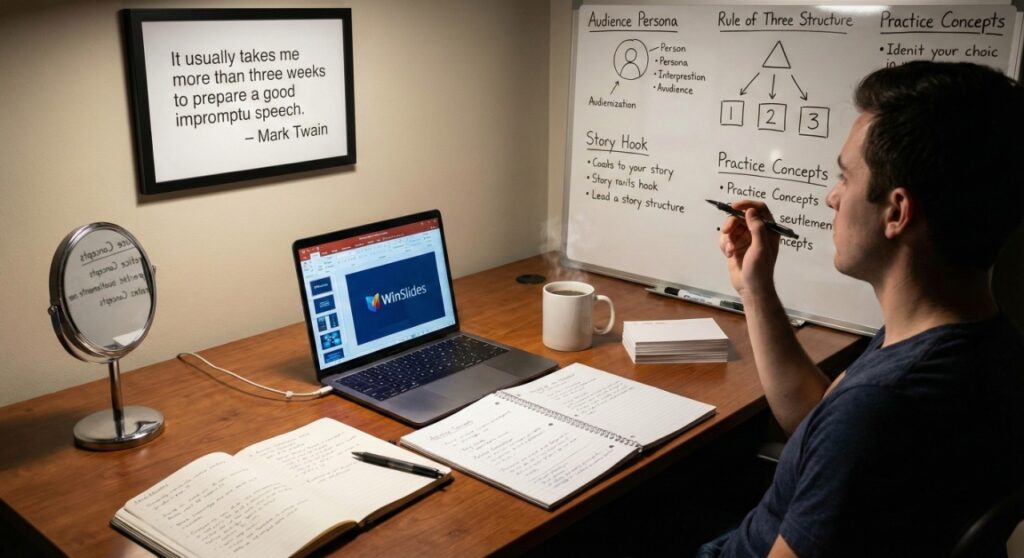
Mark Twain famously said, “It usually takes me more than three weeks to prepare a good impromptu speech.”
Confidence doesn’t come from “winging it.” It comes from knowing your material so well that you can focus on the audience, not your notes. Here is how to prepare like a pro.
1. Know Your Audience
A speech is not about you; it is about them. Before you prepare your deck, ask: Who is in the room? A technical presentation for engineers requires different language than a pitch to investors. Tailoring your content to their specific pain points and knowledge level creates an immediate connection.
2. Structure with the “Rule of Three”
People remember information in chunks of three. To make your speech sticky, structure it simply:
- Tell them what you are going to tell them (Introduction).
- Tell them (The Body – limit to 3 key points).
- Tell them what you told them (Conclusion).
3. Practice, But Don’t Memorize
Memorizing a script word-for-word is a recipe for disaster. If you forget one sentence, you will panic. Instead, memorize your concepts. Create a bulleted list of key themes and practice talking through them naturally. This makes you sound authentic rather than robotic.
4. Start with a Story
Don’t start with “Hello, my name is…”—that’s boring. Hook your audience immediately with a personal story, a surprising statistic, or a rhetorical question. Humans are wired for storytelling; a good narrative engages the brain instantly and lowers the barrier between speaker and listener.
5. Master Eye Contact
If you look at the floor or read off your slides, you lose authority. Aim to make eye contact with one person at a time for 3-5 seconds. It feels like a conversation rather than a broadcast.
- Pro Tip: If you are too nervous to look them in the eye, look at their foreheads. They won’t know the difference.
6. Watch Your Body Language
Your non-verbal cues speak louder than your words. Avoid crossing your arms (which looks defensive) or putting hands in pockets (which looks nervous).
- Do this: Stand tall with your feet shoulder-width apart and use open hand gestures. This “Power Pose” not only looks confident but actually tricks your brain into feeling more confident.
7. Embrace the Power of the Pause
Nervous speakers hate silence; they fill it with “um,” “ah,” and “like.” Confident speakers use silence as a tool. Pause before a big point to build anticipation, or pause after a big point to let it sink in. Silence commands attention.
8. Use Visuals, Not Walls of Text (The WinSlides Rule)
There is nothing worse than a speaker reading bullet points off a slide. Your slides should support you, not replace you. Use high-quality images, charts, and minimal text.
- Save Time: Don’t stress over design. Use a professional WinSlides Presentation Template to ensure your visual aids look sleek and cohesive, so you can focus entirely on your delivery.
9. Vary Your Vocal Tone
A monotone voice puts audiences to sleep. Treat your voice like an instrument. Speak louder to emphasize important points, whisper to draw them in, and speed up or slow down to match the energy of the content.
10. End with a Clear “Call to Action”
Never leave the audience wondering, “So, what now?” The last thing you say is the first thing they will remember. End with a directive:
- “Sign up for the trial.”
- “Start writing your draft today.”
- “Ask yourself this question…” Give them a clear next step to take.
Public Speaking Tips – How to Speak with Authority
You can have the best data in the world, but if you deliver it with a shaky voice and hunched shoulders, your message will get lost.
Speaking with authority isn’t about being the loudest person in the room; it is about projecting confidence and control. Whether you are a team lead or a keynote speaker, authority comes down to how you use your body and your voice.
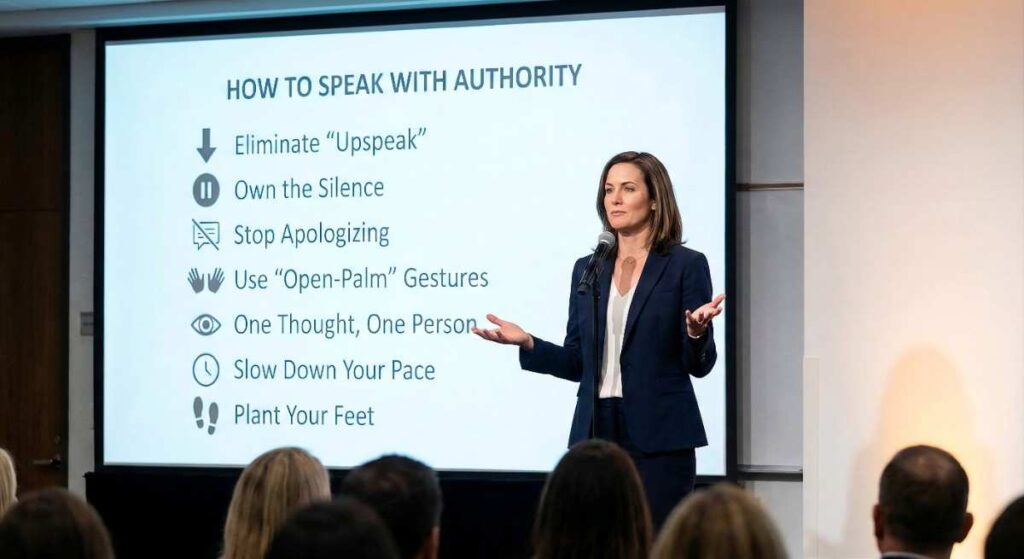
1. Eliminate “Upspeak” (The Authority Killer)
Nothing undermines your credibility faster than “upspeak”—the bad habit of raising your pitch at the end of a sentence. It makes a statement sound like a question (e.g., “We are launching on Friday?”). To sound authoritative, visualize your voice walking down stairs. End your sentences with a downward inflection to signal finality and certainty.
2. Own the Silence (The Strategic Pause)
Nervous speakers fear silence; they rush to fill every second with words. Authoritative speakers know that silence is a power move. Use a 3-second pause after making a key point. This does two things: it gives the audience time to digest your message, and it positions you as someone who is comfortable commanding the room.
3. Stop Apologizing
Start catching yourself when you use “weak” language. Avoid phrases like “I might be wrong, but…”, “I’m sorry to bother you,” or “I’m just going to talk about…”. These qualifiers tell the audience you are insecure. State your ideas directly. Instead of “I think this might work,” say “Here is why this will work.”
4. Use “Open-Palm” Gestures
Psychologically, hiding your hands (in pockets or behind your back) signals that you have something to hide. To build trust and authority, keep your hands visible and use open-palm gestures. This ancient biological signal tells the audience, “I have no weapons, I am trustworthy, and I am open.”
5. The “One Thought, One Person” Rule
Don’t scan the crowd like a lighthouse; that makes you look shifty. Instead, lock eyes with one single person for the duration of one sentence or thought. Then, move to another person for the next sentence. This creates a series of mini-conversations and makes you appear deeply engaged rather than frantic.
6. Slow Down Your Pace
When adrenaline hits, our internal clock speeds up. You might feel like you are speaking at a normal pace, but to the audience, you sound like you are in a race. Consciously speak 20% slower than you think you need to. Speaking slowly signals that you believe your words are important enough to occupy time.
7. Plant Your Feet (Stop the “Happy Feet”)
Nervous energy often escapes through our feet, causing us to sway, rock, or pace aimlessly. This is distracting. To project stability, plant your feet shoulder-width apart. If you move, move with purpose (e.g., walk to the other side of the stage to transition to a new topic), then plant your feet again. Physical stability creates vocal stability.
Visual Aids – Don’t let Bad Designs

You have prepared your script, practiced your delivery, and mastered your body language. But the moment you click “Next Slide,” the room sees a cluttered, messy PowerPoint from 2005.
Instant credibility killer
Your slides are there to support you, not to replace you. They should be the background singer, while you are the lead vocalist. If your audience is busy squinting at bad fonts or trying to decipher a complex table, they aren’t listening to a word you say.
Here is how to ensure your visuals boost your authority instead of draining it.
The “Less is More” Rule
The biggest mistake speakers make is using their slides as a teleprompter. If you put a wall of text on the screen, the audience will instinctively start reading it. And since people read faster than you speak, they will finish the slide, get bored, and check their phones.
Follow the “Billboard Rule”: Your slide should be understood in 3 seconds or less—just like a billboard on a highway.
- Cut the Text: Aim for no more than 6 words per line.
- Visualize Data: Don’t paste an Excel sheet. Use a clear bar chart or pie graph to show the trend, not just the raw numbers.
- One Idea Per Slide: Don’t cram three different topics onto one page. Spreading them out costs nothing and keeps the flow moving.
Use Professional Templates (The Confidence Hack)
Let’s be honest: half the anxiety of public speaking isn’t about the speech—it’s about the preparation. Staring at a blank white slide and trying to align text boxes can be frustrating and time-consuming.
This is where the “Confidence Hack” comes in.
When you walk onto the stage knowing your presentation looks World-Class, your posture changes. You feel more professional, so you act more professional.
Instead of fighting with formatting, use a WinSlides Professional Template.
- Save Hours of Time: Skip the design phase and go straight to adding your content.
- Look Like a Pro: Our templates are designed by experts with clean typography, consistent color themes, and high-quality vector icons.
- Focus on Delivery: When you aren’t worrying about whether your logo is pixelated, you can focus 100% on connecting with your audience.
[Button: Browse Our Best-Selling Presentation Templates]
How to Overcome Stage Fright (Immediate Hacks)
Public speaking anxiety is common. Even the most seasoned pros get butterflies before a big talk. The goal isn’t to eliminate the fear completely (which is impossible) but to manage it so it doesn’t manage you.
When your heart starts pounding, it is just your body’s “fight or flight” response kicking in. Here is how to hack your biology and regain control in minutes.
Take a Breath – “Breathe and Reframe” Technique
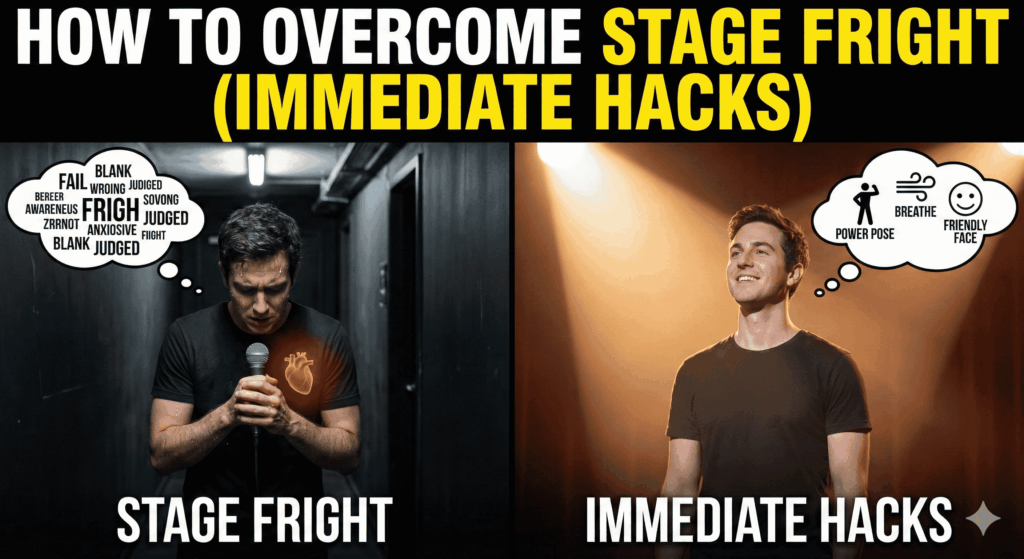
Your brain can’t distinguish between “fear” and “excitement”—physiologically, they are almost identical (racing heart, high energy). Use these tips to calm your body and trick your mind:
- Practice “Box Breathing”: This is a technique used by Navy SEALs to stay calm under pressure. Inhale for 4 seconds, hold for 4 seconds, exhale for 4 seconds, and hold empty for 4 seconds. Repeat this three times to physically force your heart rate to slow down.
- Reframe the Feeling: Don’t tell yourself, “I am so nervous.” Say out loud, “I am excited.” Since the physical sensations are the same, reframing the emotion turns that nervous energy into performance fuel rather than paralyzing fear.
- Burn the Adrenaline: Nervous energy needs an outlet. If you are backstage or in the hallway, do a few calf raises, shake out your hands, or do a quick stretch. Moving your body metabolizes the excess cortisol so you don’t shake when you stand still.
Start Strong to Build Momentum
The most terrifying part of public speaking is the first 60 seconds. Once you get past that hurdle, your rhythm kicks in and the anxiety fades. Here is how to guarantee a smooth takeoff:
- Memorize Your Opening Lines: You don’t need to memorize your whole speech, but you must memorize the first minute cold. Knowing exactly what you are going to say the moment you open your mouth eliminates the panic of “going blank.”
- Get an Early “Yes”: Start with a question that guarantees a nod or a raised hand (e.g., “How many of you have ever felt…?”). Getting the audience to respond to you immediately validates your authority and proves they are listening, which boosts your confidence instantly.
- The “Smiling” Hack: It sounds simple, but force yourself to smile when you walk onto the stage. It sends a signal to the audience that you are friendly (making them more receptive), and it triggers a dopamine release in your own brain that lowers stress levels.
- Arrive Early to Acclimate: Don’t rush in at the last minute. Arrive early, stand on the stage (if possible), and chat with a few attendees as they walk in. Turning the “scary audience” into individual humans makes the room feel much friendlier.
What are some Question About Public Speaking?
Still have some concerns? You aren’t alone. Public speaking is a dynamic skill, and even seasoned professionals run into hurdles like shaky hands or memory blanks. To help you feel fully prepared for the “what ifs,” here are quick answers to the most common questions aspiring speakers ask.
Q: How do I stop my hands from shaking? Shaking is caused by adrenaline. To mask it, avoid holding thin pieces of paper, which magnify every tremor. Instead, hold a heavier object like a slide clicker or use cue cards made of thick cardstock. You can also use “open gestures” to keep your arms moving, which burns off the adrenaline faster than holding them still.
Q: What should I do if I forget my lines? First, do not apologize or say, “I forgot.” The audience likely doesn’t know you missed anything. Pause for a drink of water (this buys you 5-10 seconds of thinking time). If you are truly stuck, look at your notes calmly, find your place, and resume. Alternatively, ask the audience a question like, “Does that make sense so far?” to reset your brain.
How long should a presentation be? As a general rule: shorter is better. TED Talks are strictly limited to 18 minutes because that is the limit of the human attention span. If you are scheduled for an hour, aim to present for 40 minutes and leave 20 minutes for Q&A. Ending early is a gift to your audience; going overtime is a sin.
Q: How do I handle a difficult question from the audience? If you get a hostile question, stay calm. Validate them first: “That is a great point, I’m glad you brought that up.” If you know the answer, give it briefly. If you don’t know, be honest: “I don’t have that specific data on me right now, but I’d be happy to look into it and get back to you after the session.” This builds trust more than faking an answer ever will.
Public speaking is not about perfection; it is about connection.
The audience isn’t there to judge you—they are there to learn from you. They want you to succeed. Remember that every great speaker you admire—from TED Talk presenters to your own CEO—started exactly where you are right now: nervous, unsure, and probably sweating a little.
The difference is, they didn’t let the fear stop them. They prepared, they practiced, and they showed up.
Now, it is your turn.
You have the tips to master your delivery. Now get the tools to master your design.
Don’t let hours of stress over PowerPoint formatting drain your confidence before you even step on stage. Browse our collection of Professional WinSlides Templates, download the one that fits your style, and walk into that room knowing you look as good as you sound.
Related Blogs
-
How to Write an Elevator Pitch: The Ultimate Step-by-Step Guide
Creative elevator pitch examples for every scenario The average human attention span is now reportedly less than that of a goldfish—about 8 seconds. In a world of endless distractions, like Instagram reels, YouTube shorts, you don’t have time for long introductions. You need to hook your audience immediately, whether you are in a networking meeting,…
-

11 Best Alternative to Slidesgo for PowerPoint and Google Slides Templates
Slidesgo Alternative You Shouldn’t Miss in 2026 For most presenters, when searching for the best free presentation templates, one name instantly strikes the mind: ”Slidesgo.” Today Slidesgo has firmly established itself as a crowd favorite—the absolute go-to for students, teachers, and creatives hunting for fun, illustrated Google Slides themes. Their platform is practically synonymous with…