
Table of Contents
- Marketing Fundamentals: Everything You Need to Know to Develop a Marketing Strategy
- The Core Pillars: The 7 Ps of Marketing (The Marketing Mix)
- Key Marketing Concepts Every Manager Should Know
- Modern Marketing Strategies: Digital vs. Traditional
- How to Structure a Winning Marketing Plan
- Tools to Visualize Your Marketing Strategy
- Final Words
- Frequently Asked Questions (FAQ)
Marketing Fundamentals: The Ultimate Guide to the 7 Ps of Marketing

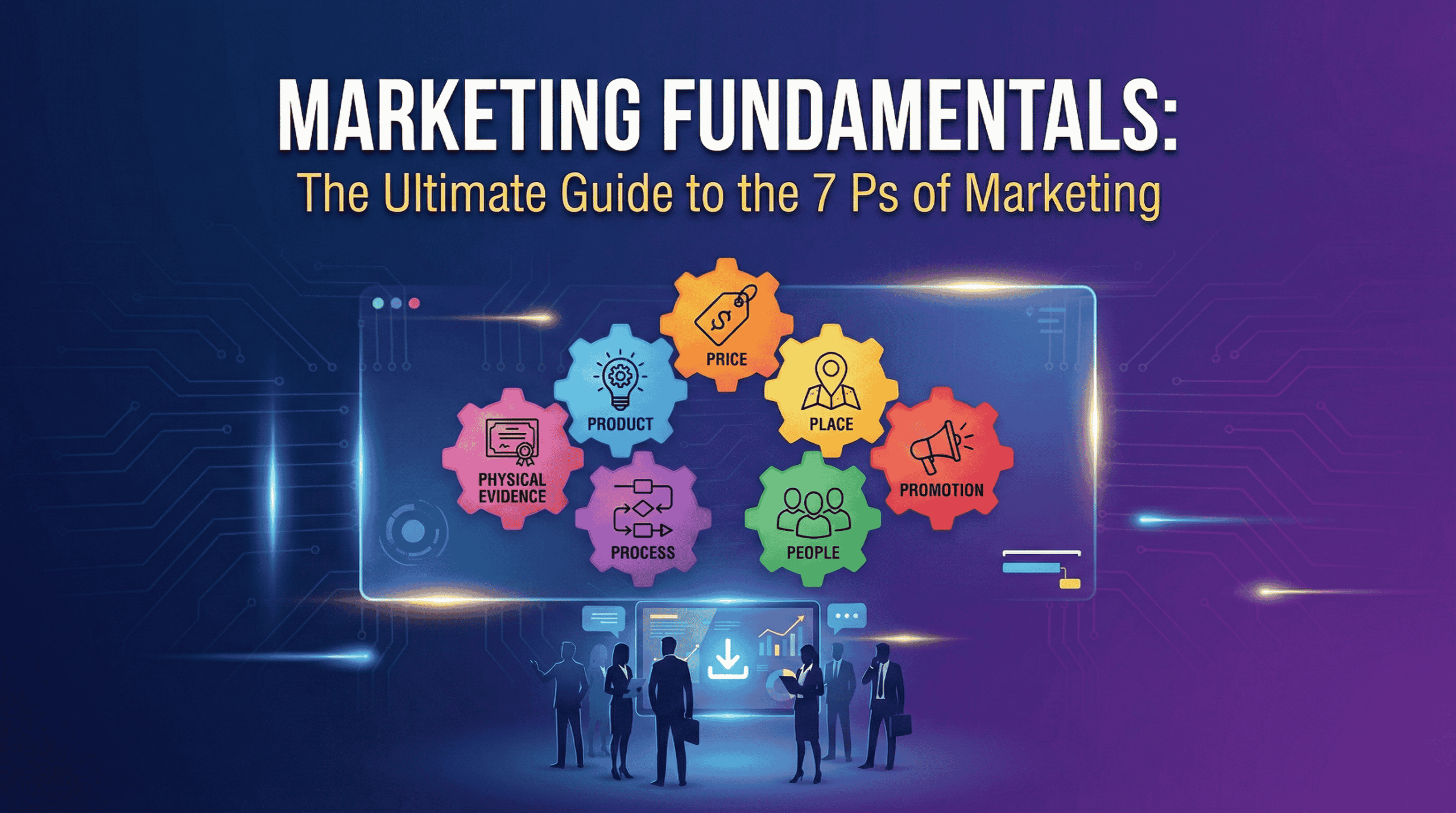


Marketing Fundamentals: Everything You Need to Know to Develop a Marketing Strategy
Marketing isn’t just advertising; it’s the engine that drives your entire business.
While catchy slogans and viral videos get the glory, the real work happens in the strategy. At its core, marketing is the process of identifying, anticipating, and satisfying customer requirements profitably.
In an era obsessed with AI tools and automation, it is easy to skip straight to the tactics. But without a solid grasp of the marketing fundamentals, even the best tools will fail. You need to understand the “why” before you can master the “how.”
By the end of this guide, you won’t just understand the core principles of the 4 Ps and strategic positioning—you will also know how to structure these ideas into a winning plan using professional planning templates to present your strategy effectively.
Let’s Dive In.
The Core Pillars: The 7 Ps of Marketing (The Marketing Mix)
For decades, marketers relied on the classic “4 Ps” (Product, Price, Place, Promotion). However, in the modern digital landscape—where services and software (SaaS) dominate—strategies have evolved. To create a truly comprehensive Marketing Fundamental strategy, you must master the 7 Ps of Marketing.
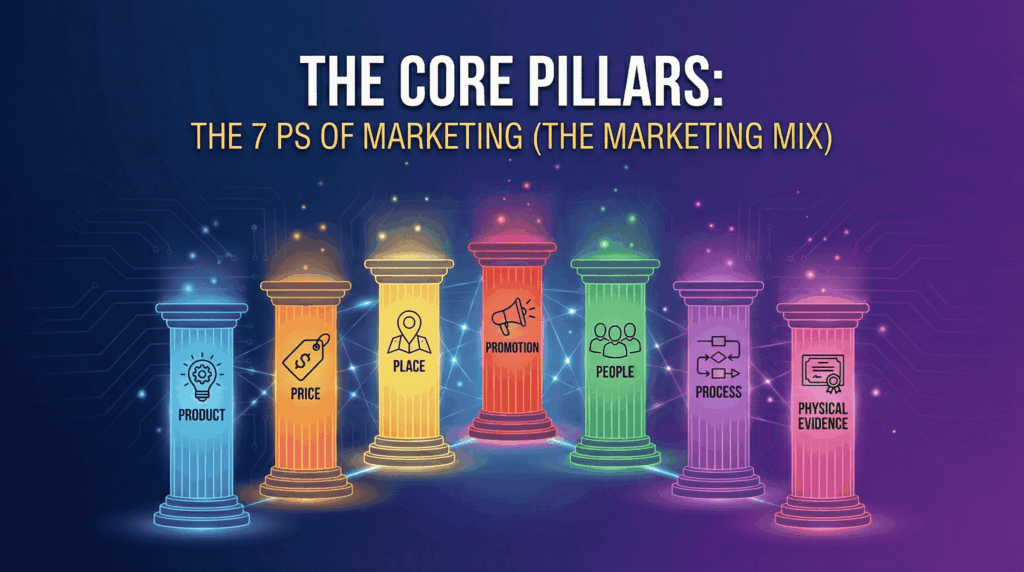
1. Product: Solving the Problem
It all starts here. Your product isn’t just a physical item; it is the solution to your customer’s pain point. Whether it’s a piece of software, a consulting service, or a pair of sneakers, you must define its Unique Selling Proposition (USP).
- Key Question: What specific problem does this solve that competitors do not?
- Pro Tip: Use a Product Lifecycle Template to map out your product’s journey from introduction to maturity.
2. Price: Determining Value
Price is the only “P” that generates revenue; the rest generate cost. Your pricing strategy must align with your brand positioning. Are you a luxury brand (Premium Pricing) or a budget-friendly option (Penetration Pricing)?
- Key Question: Is the customer willing to pay this amount for the value they receive?
3. Place: Accessibility & Distribution
“Place” refers to where and how customers buy your product. In 2026, this often means a mix of e-commerce, retail stores, or app stores. The goal is to reduce friction—making it as easy as possible for the customer to buy.
- Key Question: Is my product available where my target audience hangs out?
4. Promotion: Communication Strategy
This is what most people think of when they hear “marketing.” Promotion includes advertising, public relations, social media marketing, and email campaigns. It is how you tell the world you exist.
- Key Question: What channels (Instagram, LinkedIn, Google Ads) will best reach my audience?
Need to present this to your team? Don’t list these bullet points in a boring document. Download our Marketing Analysis Template to visualize your 4 Ps and 7 Ps strategies in a way that stakeholders will instantly understand.
5. People: The Human Element
In the service industry, your employees are the brand. From the customer support agent who answers the phone to the delivery driver who drops off the package, every human interaction shapes the customer’s perception of your company.
- Key Question: Are my team members trained to deliver the brand promise?
6. Process: The Customer Journey
Process refers to the systems and flows involved in delivering your service. A confusing website checkout, a slow onboarding email, or a complicated return policy are all “process” failures that kill marketing efforts.
- Key Question: How efficient is the journey from “interested” to “purchased”?
7. Physical Evidence: Tangible Proof
Even for digital businesses, physical evidence matters. This includes your branding, the design of your website, your invoices, and even your digital case studies. It provides the “proof” that your business is legitimate and trustworthy.
- Key Question: Does my brand looking professional and consistent across all touchpoints?
Key Marketing Concepts Every Manager Should Know
Understanding the 7 Ps gives you the framework, but to execute a campaign that actually converts, you need to master a few critical strategic concepts. These are the foundational tools that turn a generic idea into a targeted, revenue-generating machine.
1. Target Audience & Segmentation: Defining Who You Are Talking To
If you try to market to everyone, you end up marketing to no one. Market segmentation is the process of dividing a broad consumer or business market into sub-groups (segments) based on shared characteristics.
To build an Ideal Customer Profile (ICP), you need to look at two main categories:
- Demographics: The quantifiable statistics of a given population. This includes age, gender, income level, education, and geographic location. (Example: Men aged 25-34 earning over $60k/year).
- Psychographics: The deeper, psychological attributes of your audience. This covers their values, desires, goals, interests, and lifestyle choices. (Example: Eco-conscious consumers who value sustainable living and outdoor adventure).
2. Value Proposition: Why Should They Buy From You?
Your value proposition is the core of your competitive advantage. It is a clear, concise statement that explains how your product solves a customer’s problem, delivers specific benefits, and tells the ideal customer why they should buy from you instead of the competition.
It is not a slogan or a catchphrase. A strong value proposition clearly answers the question: “What is in it for me?” If your audience lands on your website and cannot identify your value proposition within five seconds, they will leave.
3. SWOT Analysis: Strengths, Weaknesses, Opportunities, Threats
Before launching any new initiative, a manager must assess the current landscape. A SWOT analysis is a strategic planning technique used to identify your business’s current position and future potential.
- Strengths (Internal): What do you do better than anyone else? (e.g., proprietary technology, a highly skilled team).
- Weaknesses (Internal): Where are you lacking resources or falling behind competitors? (e.g., limited budget, outdated software).
- Opportunities (External): What market trends can you capitalize on? (e.g., an underserved niche, new emerging platforms).
- Threats (External): What external factors could hurt your business? (e.g., new competitors, changing regulations, economic shifts).
A SWOT analysis is a staple in every marketing meeting. Don’t let a poorly formatted document ruin a great strategy. Check SWOT Analysis Slide Deck to present your internal and external findings clearly, professionally, and persuasively to your stakeholders.
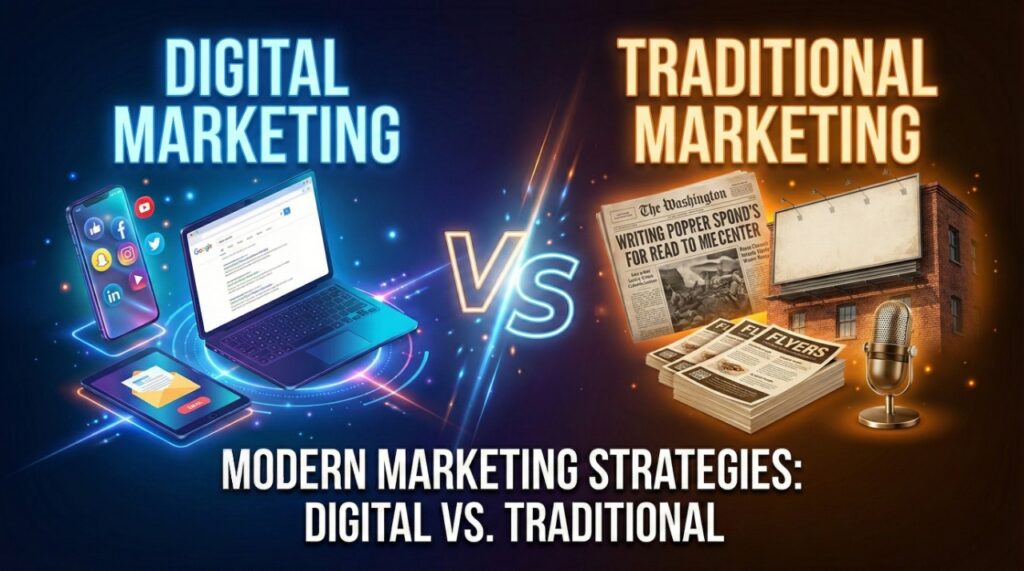
Modern Marketing Strategies: Digital vs. Traditional
Once you have your “Marketing Mix” (the 7 Ps) and your Strategy (STP & SWOT) defined, the next question is: How do you actually deliver the message?
Marketing strategies generally fall into two buckets: Traditional (Outbound) and Digital (Inbound). While traditional methods like TV ads, billboards, and print media still have their place, modern marketing fundamentals heavily rely on digital channels that offer better targeting and measurable ROI.
1. Content Marketing: Value First
Instead of interrupting customers with ads, Content Marketing attracts them by solving their problems. This includes blog posts (like this one!), videos, whitepapers, and infographics.
- Why it works: It builds trust. When you give value for free, customers are more likely to pay for your premium solutions later.
2. SEO (Search Engine Optimization)
If Content Marketing is the fire, SEO is the gasoline. It is the art of optimizing your website so that Google shows your content to the right people at the right time.
- Key Focus: Keywords, site speed, and backlinks.
3. Social Media Marketing
Social media is no longer just for brand awareness; it is a customer service channel and a sales platform. Whether it’s LinkedIn for B2B or Instagram for B2C, the goal is to engage, not just broadcast.
- Strategy: Use the “80/20 Rule”—80% educational/entertaining content, 20% promotional content.
4. Email Marketing: The Highest ROI
Despite the rise of social media, email remains the king of conversion. It is the only channel where you “own” the audience (unlike social algorithms that can change overnight).
- Best Practice: Segment your list. Don’t send the same generic newsletter to a CEO that you send to a student.
Pro Tip: Managing these channels can get chaotic. Use a Digital Marketing Calendar Template to schedule your blog posts, social media updates, and email campaigns in one central dashboard. This ensures your team stays aligned and never misses a deadline.
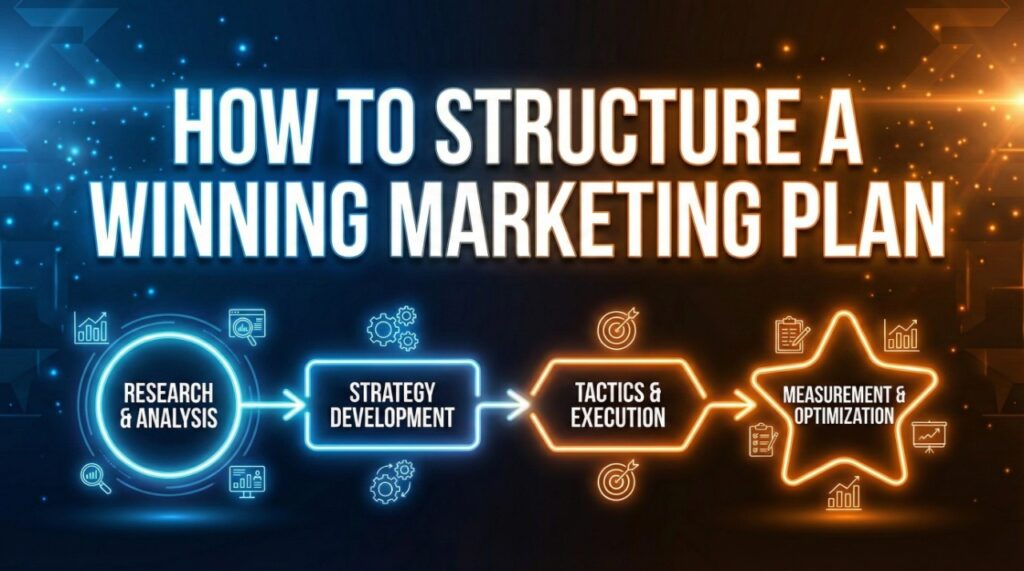
How to Structure a Winning Marketing Plan
You now understand the marketing fundamentals, the 7 Ps, and how to analyze your market. But here is the hard truth: a brilliant strategy is useless if you cannot communicate it clearly. Whether you are pitching to your CEO, trying to secure a budget, or onboarding a new marketing team, your ideas need structure. Handing stakeholders a 40-page text document will put them to sleep. You need a visual, compelling narrative.
Here is the exact 5-step framework you should use to build and present a winning marketing plan.
Step 1: The Executive Summary
Think of this as the “elevator pitch” for your entire marketing strategy. Even though it appears first in your presentation, you should always write it last. It provides a high-level overview of your primary objectives, the total budget required, and the expected ROI.
- The Goal: Give busy executives the bottom line immediately so they know exactly what they are reviewing.
Step 2: Situation Analysis
Before you explain where you are going, you must explain where you currently stand. This is where your SWOT Analysis and competitor research come into play.
- The Goal: Define the current market landscape, your target audience (demographics and psychographics), and the specific problem your brand is solving right now.
Step 3: Marketing Goals (SMART)
Avoid vague goals like “increase brand awareness” or “get more followers.” Stakeholders want to see SMART goals: Specific, Measurable, Achievable, Relevant, and Time-bound.
- The Goal: Shift from “get more leads” to “Generate 500 qualified B2B leads via LinkedIn by Q3 2026.”
Step 4: Strategy & Tactics
This is the meat of your plan. Here is where you deploy your Marketing Mix (The 7 Ps). Break down exactly how you will achieve your SMART goals.
- Strategy: The big picture (e.g., “Become the leading educational resource for SaaS founders”).
- Tactics: The daily actions (e.g., “Publish two high-quality SEO blog posts per week and launch a weekly webinar”).
Step 5: Budget & Controls
Ideas are free; execution costs money. You must outline exactly how much budget you need for ad spend, software, and personnel. More importantly, define your Controls—the Key Performance Indicators (KPIs) you will track to ensure the money is being spent effectively.
- The Goal: Show accountability. Detail how you will track metrics like Customer Acquisition Cost (CAC) and Return on Ad Spend (ROAS).
Tools to Visualize Your Marketing Strategy
Ask any seasoned manager, and they will tell you the hidden truth of the industry: Marketers spend 50% of their time doing the marketing, and the other 50% reporting on it. You can spend weeks conducting SWOT analyses, segmenting your audience, and perfecting your 7 Ps. But if you walk into a boardroom with a chaotic spreadsheet or a wall of text, stakeholders will lose confidence in your plan. Visual communication is just as important as the strategy itself.
This is exactly where Winslides bridges the gap. We specialize in reducing that 50% reporting time down to minutes by providing high-end, visual frameworks so you can focus on the actual marketing.
Instead of wrestling with PowerPoint shapes and alignment tools, you can plug your research directly into our specialized collections:
- Marketing Strategy Decks: Complete, end-to-end presentation templates that include slides for your Executive Summary, SWOT, and SMART Goals.
- Go-to-Market (GTM) Strategy Templates: Perfect for launching a new product, featuring built-in product lifecycle and competitor analysis diagrams.
- Social Media Report Templates: Clean, data-driven layouts designed specifically to showcase ROI, engagement metrics, and campaign performance to your clients or CEO.
Final Words
Mastering the marketing fundamentals is the difference between a business that merely survives and one that scales. By understanding the 7 Ps, accurately segmenting your audience, and building a structured plan, you create a revenue engine that doesn’t rely on guesswork.
But remember, a great strategy only gets funded if it is understood.
Ready to present your new marketing strategy? Download our Ultimate Marketing Presentation Bundle today and look like a pro in your next meeting.
Frequently Asked Questions (FAQ)
What is the most important rule in marketing?
The golden rule of marketing is to know your audience. If you put the customer first and deeply understand their pain points, desires, and behaviors, everything else (product development, pricing, and promotion) falls into place naturally.
What are the 5 basic concepts of marketing?
Historically, marketing management is guided by five core philosophies:
- Production Concept: Consumers favor products that are highly affordable and widely available.
- Product Concept: Consumers favor products that offer the highest quality, performance, and features.
- Selling Concept: Consumers will only buy enough of the firm’s products if the company undertakes a large-scale selling and promotion effort.
- Marketing Concept: Achieving organizational goals depends on knowing the needs and wants of target markets and delivering satisfaction better than competitors.
- Societal Marketing Concept: A company should make marketing decisions by considering consumers’ wants, the company’s requirements, consumers’ long-run interests, and society’s long-run interests.
How do I start learning marketing basics?
Start by mastering the foundational frameworks like the 4 Ps (Product, Price, Place, Promotion) and target audience segmentation. From there, consume free resources like industry blogs (HubSpot, Ahrefs), take beginner digital marketing certifications (like Google’s Digital Garage), and most importantly, practice by analyzing the marketing campaigns of brands you interact with daily.
Related Blogs
-

What is a Sales Presentation? The Ultimate Guide to Create Perfect Sales Presentation That Close Deals
How to Create a Sales Presentation – Improve your Sales Presentation Did you know that 41% of decision-makers admit to multitasking or losing focus during a sales pitch? In today’s competitive market, you have less than seven seconds to grab a prospect’s attention before they mentally check out. If your slides are cluttered or your…
-
How to Write an Elevator Pitch: The Ultimate Step-by-Step Guide
Creative elevator pitch examples for every scenario The average human attention span is now reportedly less than that of a goldfish—about 8 seconds. In a world of endless distractions, like Instagram reels, YouTube shorts, you don’t have time for long introductions. You need to hook your audience immediately, whether you are in a networking meeting,…