
Table of Contents
- Guide to Writing a Powerful Executive Summary
- What Are the 3 Elements of an Executive Summary?
- What Are the 5 Parts of an Executive Summary?
- How Do You Structure an Executive Summary?
- Best Practices and Common Mistakes to Avoid While Creating an Executive Summary
- Top Executive Summary Templates to Download in 2026
- Final Words
- Frequently Asked Questions (FAQs)
How to Write an Executive Summary (With Professional Executive Summary Templates)



Guide to Writing a Powerful Executive Summary
Let’s be honest: busy executives, angel investors, and key stakeholders rarely have the time—or the patience—to read a dense, 50-page business plan or project proposal. In the fast-paced corporate world, decisions are often made based entirely on the very first page they read. If you don’t capture their attention immediately, your hard work will go unread.
That is where this crucial document comes in. An executive summary is a condensed, one-to-two-page overview of a much larger report. It is specifically designed to highlight the most critical information, key findings, and final recommendations so the reader understands the core message instantly.
Nailing this summary is the difference between getting a project green-lit and getting ignored. In this guide, we will break down exactly how to structure your document for maximum impact. Plus, we will provide you with highly visual, professionally designed Winslides Executive Summary Templates so you can stop wrestling with formatting and make your data truly stand out.
What Are the 3 Elements of an Executive Summary?
When you strip away the formatting and the corporate jargon, every successful executive summary boils down to three core elements. If you are ever unsure what to include or feel like your document is getting too long, make sure your summary clearly hits these three fundamental pillars:
- 1. The Problem (The Need): What is the specific challenge, market gap, or internal issue that this document addresses? Every great proposal starts by identifying a clear pain point. If your stakeholders do not understand the problem, they will not care about your solution.
- 2. The Solution (The Proposal): How does your project, business, or strategy solve that exact problem? This is where you introduce your big idea, new product, or strategic shift. Keep it concise, actionable, and directly tied to the need you just outlined.
- 3. The Evidence (The Outcome): What is the data, financial projection, or return on investment (ROI) that proves this solution will actually work? Executives make decisions based on hard facts, not just good ideas. This element highlights the metrics, budget requirements, and expected outcomes that justify their buy-in.
Keeping these three elements at the forefront ensures your summary remains sharply focused on what actually matters to decision-makers, without getting bogged down in unnecessary details.
What Are the 5 Parts of an Executive Summary?
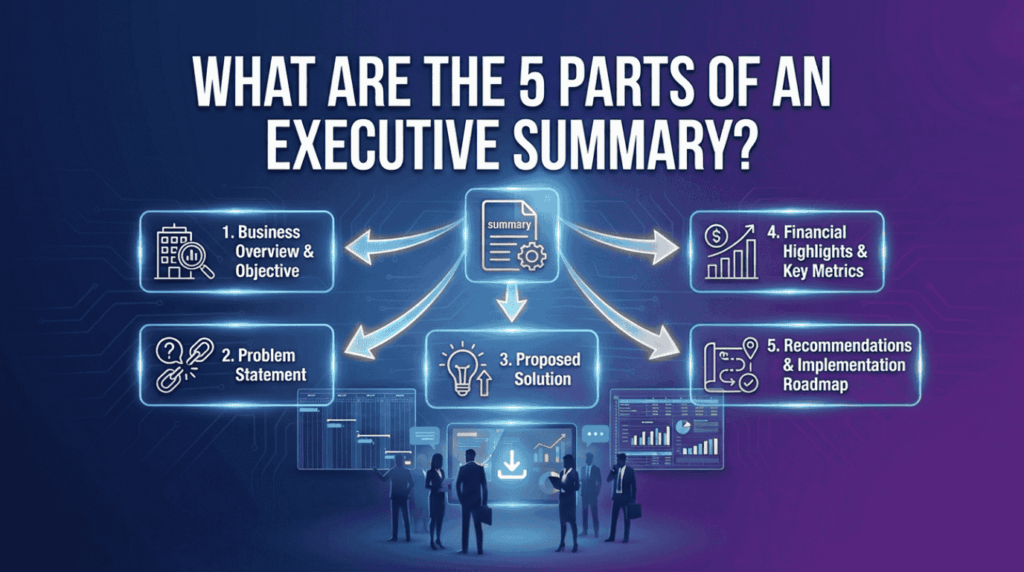
While the three core elements give you the philosophical foundation, you still need a structured anatomy to build your document. Depending on whether you are writing a startup business plan, an internal project proposal, or a new marketing strategy, the exact details will vary.
However, a comprehensive and effective executive summary typically includes these five distinct parts:
- Part 1: Business Overview & Objective: This is your opening hook. Provide a brief introduction to your company, the specific project at hand, and the primary goal of the document. Keep it high-level so the reader instantly knows who you are and why they are reading this.
- Part 2: The Problem Statement: Before you pitch a solution, you must establish the need. Offer a clear, concise explanation of the current pain points, the internal bottleneck, or the untapped market opportunity. Make the problem feel urgent and relevant to the stakeholders reading it.
- Part 3: The Proposed Solution: This is the heart of your summary. Clearly state your strategic recommendation, new product offering, or project plan. Explain exactly how this solution directly resolves the problem statement you just outlined in Part 2.
- Part 4: Financial Highlights & Key Metrics: Executives and investors want to see the numbers. Provide a high-level look at the required budget, funding requests, projected revenue, or expected Return on Investment (ROI). You do not need to show every calculation here—just the bottom-line figures that justify the investment.
- Part 5: Recommendations & Implementation Roadmap: Conclude with a clear call-to-action. What needs to happen next? Include a brief timeline of key deliverables, milestones, or the immediate next steps required to get the project approved and off the ground.
How Do You Structure an Executive Summary?
Knowing what to say is only half the battle. How you structure and present that information determines whether a busy stakeholder will actually read it. The most common mistake professionals make is treating an executive summary like a standard essay. It needs to be highly scannable, deeply logical, and visually engaging.
Here is a step-by-step approach to structuring a winning executive summary:
- Step 1: Always Write It Last. This sounds counterintuitive, but it is the golden rule of report writing. You cannot accurately summarize a 50-page business plan or a complex project proposal until you have actually finished writing the main document. Draft your entire report first, then pull the most critical insights to build your summary.
- Step 2: Know Your Audience. Before you format a single paragraph, ask yourself who will be reading this. Tailor the tone and the metrics to the specific stakeholders. For example, if you are pitching to venture capitalists, your structure should heavily emphasize market size, competitive advantage, and ROI. If you are presenting an internal project to your CEO, focus on resource allocation, timelines, and operational efficiency.
- Step 3: Use the “MECE” Principle. Top consulting firms use the MECE principle to structure their arguments: Mutually Exclusive and Collectively Exhaustive. This means your summary should not have overlapping points (Mutually Exclusive) and it shouldn’t leave out any vital information necessary to make a decision (Collectively Exhaustive). Keep your points distinct and comprehensive.
- Step 4: Prioritize Visual Hierarchy. Walls of text get ignored. Your summary should leverage short paragraphs, bolded keywords, and bulleted lists to guide the reader’s eye down the page.
The Smarter Way: Use a Visual Deck Instead of using a standard, boring Word document, smart professionals are increasingly using presentation slides to structure their summaries. A visual layout with clean icons, data charts, and color-coded sections is infinitely easier to scan than a block of text. You can achieve this premium, executive-level look instantly by downloading a Executive Summary Deck. Just drop your key points into the pre-formatted slides, and you are ready to impress.
Best Practices and Common Mistakes to Avoid While Creating an Executive Summary
Even if you have included all the right elements and structured your document logically, a few simple formatting errors can ruin your credibility. When writing your executive summary, keep these golden rules in mind to ensure your proposal hits the mark every time.
The Do’s:
- Do keep it under one to two pages maximum. Remember, this is a summary, not a substitute for the main report. If your summary spills over into three or four pages, you are including too much detail and defeating the purpose of the document.
- Do lead with the most important key takeaway. Do not bury the lead. In journalism, the most critical information goes in the very first paragraph. Apply the same rule here. State your primary objective and the bottom-line value right away so the reader is hooked immediately.
The Don’ts:
- Don’t use heavy technical jargon or unexplained acronyms. The stakeholders reading your summary might not be in your specific department. An investor might not understand complex engineering terms, and a CEO might not know the latest marketing acronyms. Write in clear, accessible language so anyone can understand your pitch.
- Don’t introduce new information. This is a common and fatal mistake. Your executive summary must only contain information, metrics, and recommendations that are fully explained in the main report. If an executive sees a surprising statistic in the summary and cannot find the supporting data in the full document, you will lose their trust.
Top Executive Summary Templates to Download in 2026
Instead of starting from a blank slide and struggling to align text boxes, you can leverage professionally designed, ready-to-use assets. Depending on your industry and your specific proposal, here are the top Executive Summary Templates to download this year:
Business Executive Summary Template with Dashboard
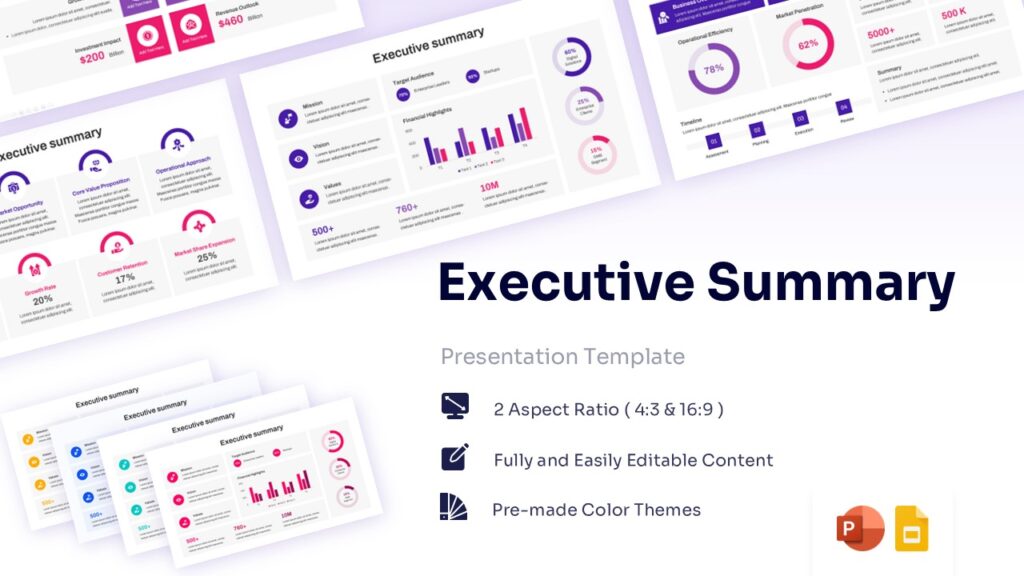
View: Executive Summary Template
Leading our list is the Professional Executive Summary Template by Winslides, expertly designed to transform dense business proposals into highly visual and easily digestible presentations. Whether you are pitching to investors or updating internal stakeholders, this template provides the perfect balance of professional design and data-driven layouts to make your key metrics stand out.
Board Meeting Minutes Template for PowerPoint and Google Slides
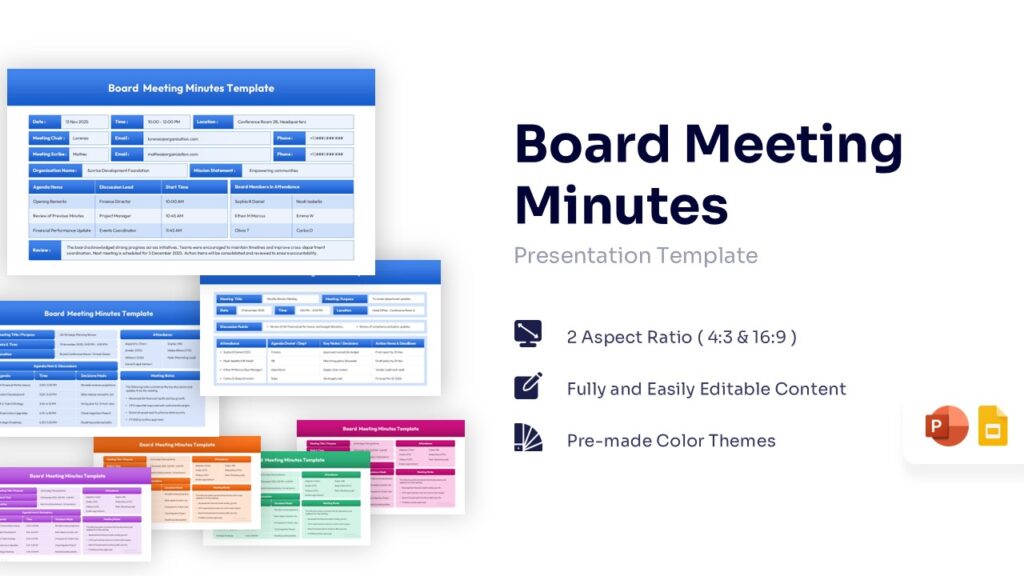
View: Board Meeting Minutes Template
Keeping accurate records of high-level decisions is just as crucial as the initial proposal, which is where the Board Meeting Minutes Template by Winslides excels. This highly structured, table-driven deck allows you to meticulously document attendees, agenda items, critical discussion points, and future action items in a clean, professional format. Fully compatible with both PowerPoint and Google Slides, it features standard and widescreen aspect ratios alongside pre-made color themes for instant brand alignment. By using this fully editable template, you can ensure your corporate documentation remains as polished and organized as your executive summaries.
Free Executive Summary Slide Template by SlideChef
View: Executive Summary Presentation Template
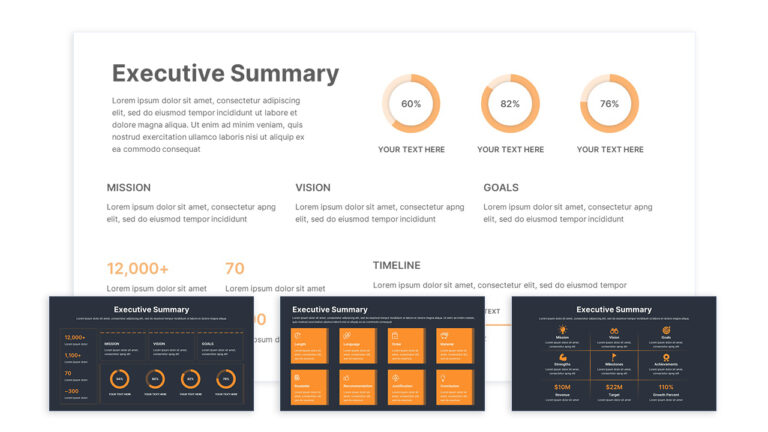
Another excellent option for your toolkit is the Executive Summary Template by Slidechef, which offers a striking contrast of clean light themes and bold dark modes to suit any presentation environment. This dynamic template features dedicated sections for articulating your company’s mission, vision, and high-level goals alongside impactful visual elements like editable donut charts. With its structured grid layouts and prominent data callouts, it allows you to present complex timelines and vital metrics in a highly organized, easily digestible manner. It is a fantastic choice for modern business leaders who need a sleek, contemporary aesthetic to keep their stakeholders focused on the most critical performance indicators.
Executive Summary Template with Metrics and Services
View: Corporate Executive Summary Template
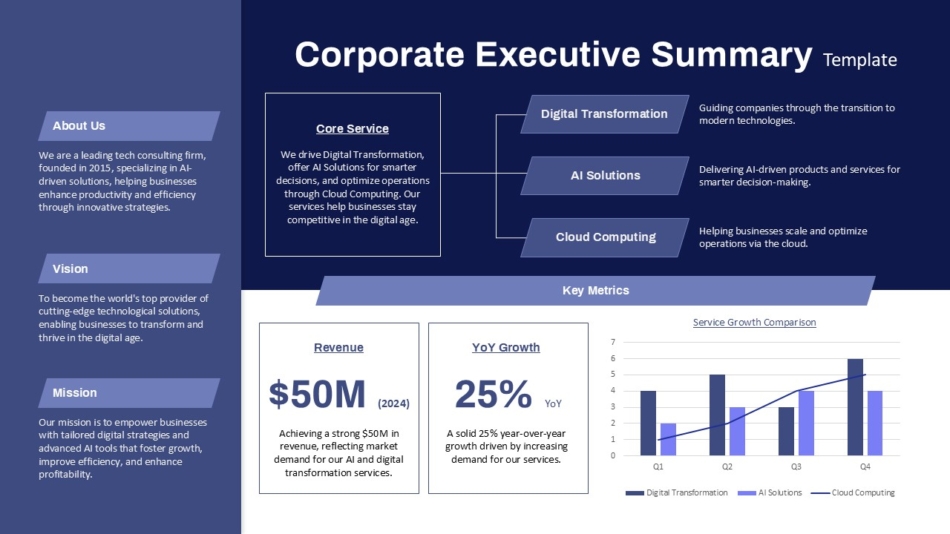
If your presentation relies heavily on financial data and performance tracking, the Executive Summary Template with Metrics is an indispensable tool. This professionally styled, dark-blue slide provides dedicated sections to clearly articulate your company’s mission, core services, and overarching vision. More importantly, it features a prominent bottom layout specifically engineered to showcase vital statistics like annual revenue, year-over-year growth, and comparative service trends using built-in bar and line charts. This highly organized format is perfect for corporate consultants, tech firms, or financial officers who need to prove their value and operational efficiency at a single glance.
General Executive Summary Template
View: General Executive Summary Template
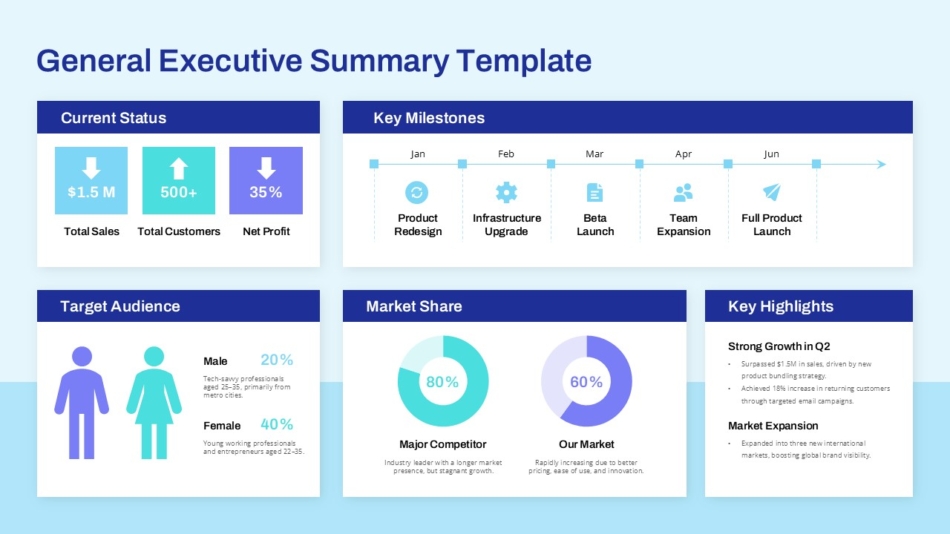
For a versatile option that covers all the fundamental bases of a business report, the General Executive Summary Template is an outstanding choice. This clean, grid-based layout features dedicated, color-coded sections to track your current financial status, map out upcoming key milestones on a visual timeline, and clearly define your target audience demographics. It also includes easy-to-read donut charts for visualizing market share against competitors, alongside a structured text area to list out key quarterly highlights and growth metrics. This comprehensive, highly organized design is ideal for team leaders and project managers who need a well-rounded, easy-to-update dashboard to present a complete snapshot of their overall business operations.
Final Words
The executive summary is undeniably the most critical component of your entire proposal. It acts as the gatekeeper for your ideas, determining whether your project gets funded, your strategy gets approved, or your hard work simply gets ignored by busy stakeholders.
Don’t risk losing your audience’s attention by presenting a wall of unformatted text, and stop wasting your own valuable time staring at a blank slide. By downloading a pre-formatted Winslides Executive Summary Template, you can save hours of tedious formatting and present your business case with absolute clarity and professional confidence.
Frequently Asked Questions (FAQs)
What is the difference between an executive summary and an introduction? An introduction merely sets the stage for the document, explains the background context, and outlines what topics will be covered. An executive summary, on the other hand, gives away the ending. It provides the actual findings, the hard data, and the final recommendations so the reader can understand the entire proposal without having to read the full report.
Can an executive summary be 2 pages? Yes. While a single, highly scannable page is always the gold standard, highly complex business plans, merger proposals, or massive corporate reports may require a two-page summary to fit all the necessary financial metrics. However, you should strictly avoid exceeding two pages.
Do you include a conclusion in an executive summary? Yes, but it is usually framed as “Recommendations,” “Implementation,” or “Next Steps.” You must conclude the summary with a definitive call to action, a timeline for deliverables, or a final verdict on the proposed solution to drive the project forward.
Related Blogs
-
How to Write an Elevator Pitch: The Ultimate Step-by-Step Guide
Creative elevator pitch examples for every scenario The average human attention span is now reportedly less than that of a goldfish—about 8 seconds. In a world of endless distractions, like Instagram reels, YouTube shorts, you don’t have time for long introductions. You need to hook your audience immediately, whether you are in a networking meeting,…
-
Marketing Fundamentals: The Ultimate Guide to the 7 Ps of Marketing
Marketing Fundamentals: Everything You Need to Know to Develop a Marketing Strategy Marketing isn’t just advertising; it’s the engine that drives your entire business. While catchy slogans and viral videos get the glory, the real work happens in the strategy. At its core, marketing is the process of identifying, anticipating, and satisfying customer requirements profitably….